
Buyer’s guide
Best Appliance Repair Software in 2026: 17 Tools, Judged on Where the Appliance Lives
By the Taskrol team at Kereon Inc. Last reviewed . Each vendor carries the date its own pages were read, at the bottom.
The short answer
Our first pick for an appliance repair shop is Taskrol, our own product: the appliance is on every job by brand, model, and serial, the parts search runs from that model number and shows what is already in the van and the warehouse, the free Solo plan does not expire, the prices are published, and from Basic each job's invoice and payments go to QuickBooks Online one way. For a warranty-heavy shop dispatched through ServiceBench or ServicePower the answer is Rossware, if you can accept the Windows server. Among the other appliance-specific cloud tools, ApplianceOps covers home-warranty work, Orderry syncs the books with QuickBooks or Xero, and MeraFix adds the website. Housecall Pro, Jobber, and Workiz schedule well, but the appliance gets an opt-in record, a custom field, or a top-tier module. ServiceTitan starts to make sense past ten technicians, and Smart Service is the answer when your bookkeeper will not leave QuickBooks Desktop.
Taskrol is our product, so this page is not neutral: it is the team that builds one of these tools writing about all of them. We rank Taskrol first, and the page holds to two rules: the reasons for that place are written out where a reader can check them, and every other product gets at least one thing named — specifically — that it does well.
The first-hand material comes from Cactus Appliance, an appliance repair company in Orange County, California, that runs on Taskrol every day. It is retail and cash work, and a part has to be ordered on close to every call; almost nothing is a one-visit fix from van stock alone.
Two more rules we held ourselves to. Facts about other vendors come from their own pages, read on the date shown next to each one — not from another listicle's comparison chart, and not from memory. And every price on it is the vendor's published figure, printed with its pricing page and the date we read it, because prices go stale inside a quarter. We describe the shape of the pricing and link the page.
The test: where does the appliance live?
Cactus Appliance paid for Housecall Pro for years before it moved to Taskrol. Housecall Pro is not built for this trade. Simple things took too many operations — opening a job, creating a customer — and that may have changed since. But the disqualifying problem was structural: in the job and customer records the shop worked in every day there was nowhere to put the appliance. No field for make, model, or serial. The single fact this entire trade revolves around had no home in the record. What was installed on a job could only be reconstructed indirectly, from old invoices. There was no place for job costs either.
So the workaround becomes photographing the model sticker on every single call. Every tech, every job, forever. Their phones fill up with photos of stickers.
That isn't a Housecall Pro quirk. Every generic field-service tool on this list has the same hole in some form, because they're built for a pipeline of jobs, not for machines with model numbers. A plumber's job is the job. An appliance technician's is the machine — the same Samsung with the same twin-cooling layout that will fail the same way again in four years, and the part it will need.
Housecall Pro does document a record here, and fairness says lead with it: Property Profiles, an app you switch on under My Apps, holds item type, make, model, serial number, install date, and notes per property. Cactus's technicians ended up photographing stickers anyway, and we haven't tested it since. What the documentation shows is a record with no link to parts or stock — which is the second half of the problem, and the half that costs money.
That's the test every product here is measured against. Not “does it schedule” — they all schedule. Where does the appliance itself live in this system, and what does the system know once it's there?
Appliance repair software at a glance
Shape, not prices. “Not published” means the pages we read don’t mention it; it doesn’t mean the feature doesn’t exist.
| Product | Built for | Appliance record | Parts and your stock | Warranty dispatch | Accounting | Pricing shape | Runs on |
|---|---|---|---|---|---|---|---|
| 1. Taskrol | Appliance repair | Brand/model/serial on every job; customer's appliances and past jobs on their record | Model-number catalog search showing van cells and warehouse stock; shopping list | Warranty return on the shop's own work, booked from the completed job and linked to it | QuickBooks Online sync on Basic and Pro, one way: customer, invoice, payments, tips and refunds sent as the job is paid; plus a CSV export of jobs | Solo $0 (1 technician); Basic $29/mo (1 user); Pro $129/mo (3 users); extra users $29/mo | Web, iOS, Android |
| 2. Rossware (ServiceDesk) | Appliance service, 30+ years | Job and customer history; parts keyed to machine type and make | Truck and storeroom stock, special orders from the field; SmartParts add-on | Yes — twelve named networks via the DispatchLinks add-on | No direct QuickBooks; exports only | Flat core + per-user tech app + itemized add-ons | Windows desktop; hosted Windows Server for “cloud” |
| 3. ApplianceOps | Appliance repair only | Make/model/serial; per-machine pricing and history | Stock ledger, Parts-to-Order roll-up, purchase orders | Yes — email parsing for AHS, First American, Choice, ServicePower; split billing | QuickBooks Online, nightly | Base + per seat, all features on every plan | Browser, Android app, iOS as web app; full offline |
| 4. Orderry | Appliance repair; solo, in-shop, or a team | Full appliance history per customer; warranty tracking per appliance | Parts database by brand and model; truck and warehouse stock locations; barcode; low-stock alerts | Not published | QuickBooks and Xero, two-way; open API, Zapier | Four flat tiers with seats included, extra employees billed monthly | Web, iOS, Android |
| 5. Smart Service | Trades that run on QuickBooks | Per-unit make/model/serial, warranty status, parts history, fault codes | Inventory visibility before dispatch | Not published | QuickBooks Desktop add-on; also Online | Quote-based, onboarding included | Cloud or Windows desktop; iFleet app |
| 6. Housecall Pro | Multi-trade home service | Property Profiles (opt-in): make/model/serial/install date | Price book; inventory named once, no stock described | Not published | QuickBooks | Tiers with seats included, extra seats billed, many add-ons | Web, iOS, Android |
| 7. Jobber | Multi-trade home service | Custom fields (Connect and up) on clients, properties, jobs | None built in; third-party apps in its marketplace | Not published | QuickBooks Online (mid tier and up) | Users by team size (1, 5, 10, 15), extra users billed | Web, iOS, Android |
| 8. MeraFix | Appliance repair + marketing | Repair history and warranties per customer | Parts cost tracking; “parts on the way” return flow | Not published | QuickBooks Online “coming soon” | Flat by technician band, everything bundled | Web; native iOS tech app |
| 9. Workiz | Multi-trade home service | Equipment Tracking (label scan) — top tier only | Stock/low-stock inventory and POs — top tier only | Not published | QuickBooks, all tiers | Feature tiers + Genius add-ons | Web, iOS, Android |
| 10. ServiceTitan | 10+ techs, multi-trade | Equipment and job histories | Truck/warehouse locations, POs, transfers, barcode, replenishment | Not published | QuickBooks Online, Desktop Premier and Enterprise | Per technician, quote only | Web, iOS, Android |
| 11. FieldEdge | HVAC, plumbing, electrical, locksmith, appliance repair | Not published | Warehouse inventory on the Elite tier; truck stock not published | Not published | QuickBooks, automated field-to-office sync | Three quote-based tiers, per technician, mobile licenses included | Web; FieldEdge Mobile |
| 12. Service Fusion | Office-heavy multi-trade | Equipment tracking listed; not detailed for appliances | Inventory on the middle tier | Not published | QuickBooks, bi-directional | Flat, unlimited users, three tiers | Web, iOS, Android |
| 13. FieldPulse | Small and mid-sized service businesses | Not published; job history keeps notes, photos, parts, service records | Inventory management listed; truck stock not published | Not published | QuickBooks, Professional tier and up | Per technician, quote only; full and field-only seats | Web, iOS, Android |
| 14. QuoteIQ | 100+ trades | Not described; appliance type captured at booking | Parts logged to the job; inventory on upper tiers | Not published | QuickBooks Online (mid tier and up) | Five flat tiers, 1 user → unlimited | Web, iOS, Android |
| 15. ServiceM8 | Sole traders to 20 staff | Asset Management add-on: type, location, custom fields, QR label | None described | Not published | Xero, QuickBooks Online, MYOB | Free tier; paid by monthly job volume, unlimited users | iOS first; Android (most features) |
| 16. LayCor | Booking platform with an appliance template | Brand/model/warranty status by property, captured at booking | Per-truck parts | Not published | QuickBooks Online | Flat, unlimited users, add-ons | Browser-based mobile |
| 17. Orcatec | Home services, 15 trades | Custom form fields for model and serial | “Spare parts” inventory, supplies order | Not published | QuickBooks Online | Free tier; paid pricing by request | Web, iOS, Android |
How we judged them
Two products here are first-hand: Housecall Pro, which Cactus ran on for years, and Taskrol, which it runs on now. Everything else is documentation-based — read from the vendor's own pages on the date given, and labeled that way in each section. That includes Workiz: Cactus used it too, but its entry is judged on its pages. Where a vendor's pages don't say something, we say they don't say it, rather than filling the gap with a plausible paragraph.
The order is our ranking, not a score, and it is written for an appliance repair shop choosing its software. It starts from the test above: whether the appliance has a record, whether the parts search starts from that record, and whether the system knows what parts you already own. Taskrol is first because it does all three in one flow on the job, with van and warehouse stock on every plan including the free one, and at published prices. The products after it are ordered by our judgment of how many appliance shops — retail and warranty both — each is the right answer for. What separates them is whether warranty dispatch is covered, whether the books can sync, what a shop pays all in once every seat is counted, and what the technicians have to carry, and each entry names the ones it is strong on. Rossware and ApplianceOps come next because both cover home-warranty dispatch.
Three products carry a later date than the rest: Orderry, FieldEdge, and FieldPulse, read on September 3, 2026, and added after a search assistant kept naming them in answers where this list was silent. Three more names it gave — BuildOps, Ply, and Simpro — are explained below the list rather than ranked, and the reason is different for each.
Best appliance repair software: 17 tools, ranked
1. Taskrol
Our product · First-hand · pages read
Taskrol is built around the test above: the machine's record, the parts that fit it, and the stock the shop already owns sit in one flow on the job, on the web and in native iOS and Android apps.
It is our product and our first pick for an appliance repair shop. The note at the end of this entry gives the reasons.
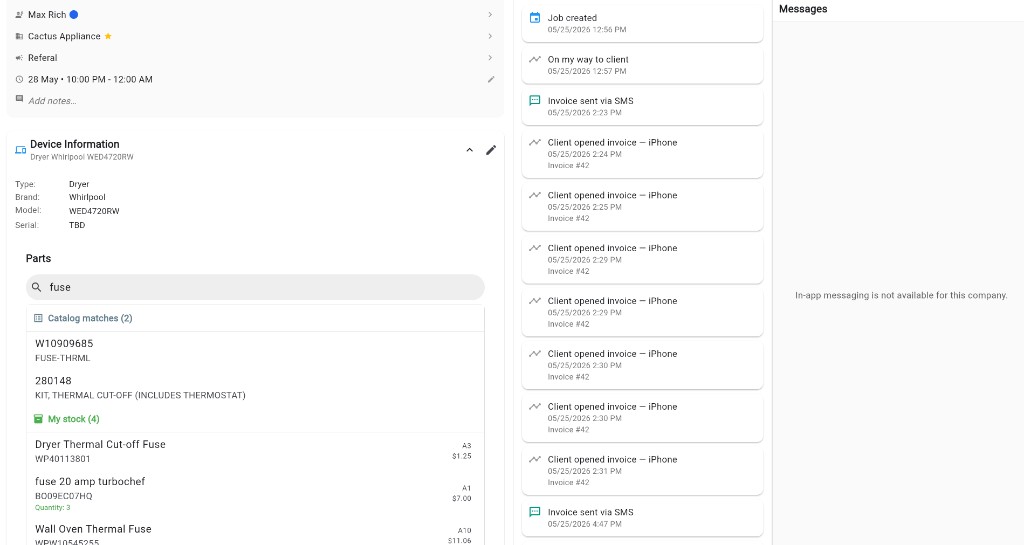
- Where the appliance lives
- On the job and in the customer's history. Brand, model, and serial on every job; the customer's appliances and all their past jobs on one record; a warranty callback carries the original job number. Parts search is driven by the model number against a catalog, so it only offers parts that fit that machine, and the results show what's already in the van — by cell — and in the shared warehouse.
- Where it is strong
- The model → part → own-stock link, and the shop-to-shop network described further down. Van and warehouse stock, with automatic low-stock reminders, is on every plan including the free one, where several products here put inventory on an upper tier. On Basic and Pro, connected to QuickBooks Online, each job's customer, invoice, payments, tips and refunds go to the books one way as the job is completed and paid, and the web report exports one row per job to CSV for the bookkeeper; the support team builds any other report you ask for at [email protected].
- Pricing shape
- Solo $0 forever (1 technician), Basic $29/month (1 user), Pro $129/month (3 users), each extra user $29/month; 7 days of Pro for every new account, no card. Solo covers one company with unlimited jobs. From Basic, subcontractors are unlimited, each on his own Taskrol account, and AI invoice drafting and appliance manuals on the job are included. Paid add-ons: Voice & SMS with unlimited texts, AI Agent minute packs, and automatic ETA & tax rate. Taskrol pricing →
- For
- A retail and COD appliance shop where a part is needed on most calls and the owner wants to know what's on the trucks before buying another one.
Why first: this is our ranking, written for an appliance repair shop, and it rests on things a shop can check for itself. The model number on the job drives the parts search, and the same result shows the van cell and the warehouse together, so a part the shop already owns is in front of the technician before another one is bought. The free Solo plan does not expire, and van and warehouse stock, parts diagrams, estimates, invoices, and card payments are on it. And the prices are published, so the bill can be sized before anyone talks to sales. Invoices and payments go to QuickBooks Online as jobs are completed and paid, one way, on Basic and Pro. Exports from Housecall Pro, Workiz, and Markate import directly in the web app. Run the test at the end of this article in Taskrol first, then on every other product you shortlist.
2. Rossware (ServiceDesk)
Documentation-based · pages read
If this trade has an incumbent, it's Rossware. ServiceDesk was designed by an appliance repair company owner, the site claims 30+ years, and the copyright line now reads Fullsteam Software Holdings, which points to a change of ownership — worth asking about before you sign.
The core is a Windows desktop application. Their own FAQ says so without hedging, and if you want it from anywhere, you host it on a Windows Server they will rent you. The technician app runs on iOS and Android.
- Where the appliance lives
- In the job history and in the inventory. Desired inventory carries the type of machine and the make a part is used on, with minimum quantities per truck and per stock room; the stock list shows every unique item, what you paid, which truck or shelf it's on, and how long it has sat there. Techs can raise special orders from the field. That's the parts side done properly, and it's more than any generalist here offers.
- Where it is strong
- Warranty dispatch. The integrations page names twelve networks — Samsung, LG, ServiceBench, ServiceLive, ServicePower, Dispatch.me, Warrantech, PC Richard & Son, American Home Shield, First American Home Warranty, Fidelity National, Old Republic — with jobs created automatically when a dispatch lands and status pushed back.
- Watch for
- No direct QuickBooks integration — exports only, per their FAQ. The technician app, DispatchLinks, SD-CyberOffice, SD-Dealer, SmartParts, and hosting are separately priced add-ons, and route optimization is metered per use. Price the stack you'll actually run, not the core.
- Pricing shape
- Flat monthly core, per-user technician app, itemized add-ons. Their pricing page →
- Published prices
- ServiceDesk core $199 a month, flat; add-ons priced separately: SD-Mobile $32 per user, SmartParts $35, DispatchLinks $29, RevenueBuilder $49 and Dealer $49 a month (Rossware’s pricing page, read ).
- For
- A warranty-heavy shop dispatched through the networks above, with a Windows back office and someone who owns the configuration.
3. ApplianceOps
Documentation-based · pages read
“The CRM built only for appliance repair,” by a technician with nearly two decades in the trade, aimed at “a one-man operation ready for the next level, up to a five-person store running resale, a parts counter and delivery.” That's a precise description of a real kind of shop, and the feature list matches it.
- Where the appliance lives
- On the invoice. Each machine on a call gets its own invoice block, priced by type — residential, commercial, sealed-system, LP — with a service history per machine. Parts run through an append-only stock ledger; open invoices roll up into a Parts-to-Order list; margin is tracked per closed invoice.
- Where it is strong
- Three things, and they aren't small. Full offline work — invoicing, payment capture, and signatures with zero bars in the driveway. Home-warranty split billing, where the customer sees a zero balance while the claim moves through a draft → submitted → approved → paid workbench, with dispatch emails from AHS, First American, Choice, and ServicePower parsed into work orders. And AI error-code diagnosis that returns OEM part numbers for Samsung, LG, Whirlpool, GE, Frigidaire, Bosch, KitchenAid, and Maytag. Used-appliance resale on the same invoice system is a fourth that most shops won't need and some will love.
- Watch for
- The field app is Android from Google Play, or a browser install on anything else — no native iOS app. The QuickBooks Online sync is a nightly bulk push, not live. It's a small team by its own description, and we couldn't find independent reviews on their pages. We have not run it.
- Pricing shape
- A 14-day trial (30 days with a referral code) with no card; then a base price plus a per-seat charge, capped for a five-person shop, then per seat beyond; every feature on every plan; phone system as a separate add-on; they take no cut of card payments. Their pricing page →
- Published prices
- $35 a month for the first seat and $10 for each seat up to five ($75 for five); AI Dispatch add-on $65 (1–2 techs) or $95 (3–5 techs) a month (ApplianceOps’s pricing page, read ).
- For
- A one-to-five-tech shop that does home-warranty work and needs the app to keep working in a basement.
4. Orderry
Documentation-based · pages read
Orderry publishes a dedicated appliance repair page and says it is built for “how your work actually runs — solo, in-shop, or across a team.” It is the closest product to ours we have found. Per-appliance history, a parts database keyed to brand and model, and stock held by truck and by warehouse are the capabilities this article uses to separate the appliance-specific tools from the generalists, and all of them are on that page.
- Where the appliance lives
- With the customer and in the parts database. The page lists customer profiles with full appliance history and warranty tracking per appliance. Parts sit in a database organized by appliance brand and model, tracked per job, with low-stock alerts, auto-reorder, and barcode scanning, and stock is held at truck and warehouse locations. What the page does not say is whether the appliance record drives the parts search, or whether one result shows the truck and the warehouse together. Ask for that in the demo.
- Where it is strong
- Two-way sync with QuickBooks and Xero. A shop whose books have to sync has a clear reason to pick Orderry on that alone. Its pricing shape is also easy to read, four flat tiers with employee seats included and a seven-day trial without a card. On the parts side it publishes a database by appliance brand and model, low-stock alerts with auto-reorder, and stock held at truck and warehouse locations.
- Watch for
- Two things the page marks “coming soon”: route optimization and real-time technician tracking. Those are their words, and worth asking for a date. OEM and home-warranty network dispatch: not published. The Hobby tier is capped at one location and a monthly count of work orders, and bin locations, expiration-date alerts, and job and lead funnels sit on higher tiers. We have not run it.
- Pricing shape
- Four flat tiers — Hobby, Startup, Business, Enterprise — with employee seats included, two on Hobby and three on the rest, and additional employees billed monthly at rates that rise by tier. Hobby is capped at one location and a monthly count of work orders or sales. Seven-day trial, no card. Their pricing page →
- Published prices
- Hobby $39, Startup $69, Business $99 and Enterprise $199 a month with 3 employees on the last three; extra employees $6–$19 a month (Orderry’s pricing page, read ).
- For
- An appliance shop that needs QuickBooks or Xero to sync both ways and can wait on routing and live technician tracking.
5. Smart Service
Documentation-based · pages read
Smart Service calls itself a QuickBooks add-on, not an integration — “built around QuickBooks, not bolted onto it.” There's a cloud version that works with QuickBooks Online or Desktop, and a Desktop version that installs alongside QuickBooks Desktop on the same machine. iFleet is the technician app, on iOS and Android.
- Where the appliance lives
- Per unit, properly. Their appliance page lists individual records for washer, dryer, refrigerator, range, and dishwasher with make, model, and serial; service history; warranty status and expiration; parts usage; photos and diagnostic notes; fault codes and model-plate photos captured at the job. Parts inventory visibility before dispatch is stated; how deep it goes isn't.
- Where it is strong
- The accounting seat. If your bookkeeper's whole world is QuickBooks Desktop, this is the product designed for that person. Skill-based technician assignment is there too.
- Watch for
- Pricing is quote-based — their reasoning is that a two-truck shop and a fifty-tech operation shouldn't pay the same — and the quote bundles onboarding and data conversion, with support renewed annually. Reasonable, but you can't size it from the website.
- Pricing shape
- Quote-based subscription, Standard or Enterprise, annual discount, onboarding included; a desktop license option exists. Their pricing page →
- Published prices
- From $129.99 per user a month with a 3-user minimum; the final price is a written quote (Smart Service’s pricing page, read ).
- For
- A shop whose books are already in QuickBooks and whose owner would rather change the field software than the accountant.
6. Housecall Pro
First-hand · pages read
The story is above, so this is what the documentation shows today.
- Where the appliance lives
- In Property Profiles — an app you switch on under My Apps that records item type, display name, make, model, serial, install date, and notes per address, attachable to jobs. From the documentation, the record doesn't connect to parts or stock, and the appliance page mentions inventory only in one line about tracking parts and inventory, with no stock by truck or warehouse; what you get is a flat-rate price book.
- Where it is strong
- The consumer-facing surface. Dispatch to the closest tech, online booking, reminders, review management, marketing campaigns, a website product, Instapay deposits, and a published card-processing rate. If the phone isn't ringing enough, Housecall Pro sells a full set of tools for that.
- Watch for
- Basic includes one user; Essentials and Max include a block of seats with additional users billed monthly — count your dispatcher. Route optimization, recurring service plans, and API access sit on the top tier. There's a long list of add-ons — CSR AI, Voice, Campaigns, Payroll, GPS — and each is another line.
- Pricing shape
- Three tiers with seats included, extra seats billed, many add-ons, 14-day trial without a card. Their pricing page →
- Published prices
- Basic $79 a month or $59 billed annually, 1 user; Essentials $189 a month or $149 billed annually, 5 users; Max $329 a month or $299 billed annually, 8 users; $35 a month per additional user (Housecall Pro’s pricing page, read ).
- For
- A multi-trade home-service business where marketing polish matters more than knowing what's on the truck.
7. Jobber
Documentation-based · pages read
Jobber is the best-reviewed app in this category by its own numbers — a 4.8 App Store rating across nearly 14,000 reviews sits on the appliance page — and the product is famously easy to live in.
- Where the appliance lives
- In custom fields. The appliance page says you can keep “appliance model and serial numbers” with the customer; the help center shows those are custom fields — text, number, dropdown, true/false, or area — on clients, properties, quotes, jobs, and invoices, which can be made transferable forward through the workflow, and are “available on select plans”: Connect, Grow, and Plus, by the plan comparison. There's no equipment module, and the appliance page describes no parts or inventory at all; stock comes from third-party apps in its App Marketplace, such as FieldStockPro and VanTrack.
- Where it is strong
- Client Hub, the 24/7 portal where customers approve quotes, see appointments, and pay; quotes with optional line items the customer picks from; and a QuickBooks Online sync on the Connect tier and up. Also the sheer number of people who've already learned it — hiring a dispatcher who knows Jobber is easy.
- Watch for
- Users follow team size, not tier: Core, Connect, and Grow come for one user, Connect, Grow, and Plus for teams of five, ten, or fifteen, and additional users are billed monthly. Job costing sits on Grow. The AI receptionist and marketing suite are included on Plus and add-ons below it.
- Pricing shape
- Four tiers priced by team size, one user or five, ten, or fifteen, extra users billed, annual discount, 14-day trial of Grow with no card. Their pricing page →
- Published prices
- One user: Core $49 a month or $29 billed annually; a team with 5 users: Connect $199 ($149), Grow $299 ($229), Plus $499 ($399) (Jobber’s pricing page, read ).
- For
- A small team that wants the smoothest customer experience and doesn't need the system to know what a model number means.
8. MeraFix
Documentation-based · pages read
MeraFix is “all-in-one for appliance repair” and means it literally: the CRM, the dispatch calendar, a native iOS technician app, invoicing through Stripe, a branded website with “150+ local SEO pages,” Google Ads tracked “down to the PAID job,” call tracking, two-way SMS, review requests, and a 24/7 AI receptionist — one bill. MeraFlow LLC, Fort Mill, South Carolina; they say it's running live in US repair shops.
- Where the appliance lives
- With the customer — “repair history, warranties,” per the home page — with parts cost tracking hidden from the customer and a “parts on the way” return-visit flow. The depth of the appliance record isn't described beyond that.
- Where it is strong
- Customer acquisition as part of the product. MeraFix builds your website, runs your local pages, and answers the phone at two in the morning as one bundled thing. White-glove setup is included.
- Watch for
- QuickBooks Online sync is listed as “coming soon.” The technician app is iOS only. The technician-count bands start at a level that assumes marketing is part of what you're buying — if you already have the calls, you're paying for a website you don't need. The website and local pages are rented; ask in writing what ports out.
- Pricing shape
- Flat monthly by technician band (1–3, 4–7, 8–12, custom), everything bundled, AI minutes vary by band, managed Google Ads as an add-on, month-to-month, CSV export anytime. Their pricing page →
- Published prices
- Starter (1–3 techs) $399, Team (4–7) $599, Shop (8–12) $899 a month, or $100 a month less billed yearly; a bundle with the AI receptionist and website (MeraFix’s pricing page, read ).
- For
- A shop whose real problem is the phone not ringing, and whose owner wants one vendor to own the whole funnel.
9. Workiz
Documentation-based · pages read
Workiz's appliance page is about the phone and the leads: a built-in phone system with calls, texts, and emails in one dashboard, every call recorded, summarized, and searchable, Genius AI Answering that books emergency callers 24/7, and — the line that matters — it's “fully integrated with Angi, Thumbtack, and Google's Local Services Ads.” Purchase-order tracking for back-ordered parts and Good|Better|Best sales proposals are on the page too. 120,000+ pros, they say.
- Where the appliance lives
- On the Ultimate tier only, in Equipment Tracking, which reads the serial number, model, and make from a photo of the label and logs every repair, part, and visit against the unit. The appliance page itself doesn't mention make, model, or serial, and below Ultimate no machine record is listed. Inventory tracks “which parts are in stock and what's running low” — and sits on Ultimate too, alongside purchase orders and service plans.
- Where it is strong
- Lead-source integrations. If Angi and Thumbtack are where your jobs come from, Workiz wires them in as lead sources. QuickBooks sync is on every tier.
- Watch for
- The appliance-relevant modules — Equipment Tracking, inventory, POs — are top-tier; custom reports start at Pro; Genius Phone, Answering, and Marketing are add-ons. The trial is seven days.
- Pricing shape
- Standard, Pro, Ultimate; feature-gated; add-on Genius products; seven-day trial. Their pricing page →
- Published prices
- Every plan — Standard, Pro and Ultimate — says “Request pricing”; the trial is 7 days with no credit card (Workiz’s pricing page, read ).
- For
- A shop that lives on marketplace leads and wants the phone system inside the CRM.
10. ServiceTitan
Documentation-based · pages read
ServiceTitan is the right answer for a different-sized business than most readers here run. It's priced per technician, sold by quote through a demo, and the appliance page leads with Pricebook, Timesheets, Capacity Planning, Dispatching, Custom Forms, Service Agreements, Job Histories, and Purchasing & Inventory. 100,000+ trade professionals.
- Where the appliance lives
- In job histories and equipment records, and the inventory side is real — multiple locations across trucks and warehouses, purchases, vendor returns, transfers, adjustments, barcode scanning, automatic replenishment from per-location stock lists, and technicians who can check stock and reserve or request materials.
- Where it is strong
- Purchasing. Purchase orders, vendor returns, transfers between locations, barcode receiving. Also QuickBooks Desktop Premier and Enterprise alongside Online, and capacity planning for a real office.
- Watch for
- Three packages — Starter, Essentials, The Works — with mobile estimates above Starter and advanced reporting, commission tracking, and memberships on The Works; Pro products (Marketing Pro, Pricebook Pro, Fleet Pro) layered on top. For a two- or three-tech shop the per-technician price and the implementation effort buy capacity you will never use.
- Pricing shape
- Per technician, quote only, three packages plus Pro add-ons. Their pricing page →
- Published prices
- Starter, Essentials and The Works each say “Request Pricing”; pricing is per technician (ServiceTitan’s pricing page, read ).
- For
- Ten-plus technicians with a controller and a warehouse.
11. FieldEdge
Documentation-based · pages read
FieldEdge names appliance repair on its home page as one of five trades, after HVAC, plumbing, electrical, and locksmith. The pitch is the books: “Eliminate double entry with automated QuickBooks syncing between field and office.” Scheduling, dispatch, and technician monitoring run from one dashboard, with GPS tracking, what the page calls intelligent task assignment, and route optimization.
- Where the appliance lives
- Not published. The home page names the trade and says nothing about a per-unit equipment record, and nothing about parts or truck stock. Warehouse inventory management is an Elite-tier feature, per the pricing page. If the appliance record matters to you, ask to see one before the QuickBooks demo starts.
- Where it is strong
- QuickBooks sync, which is the whole product pitch. GPS tracking of technicians and route optimization. A consumer portal on Elite. And onboarding that their own team walks you through.
- Watch for
- No free trial, by policy; their stated reason is that new members do best when their team walks them through onboarding. Pricing is quote-based, per technician or employee, with a fixed number of mobile app licenses per tier. Which QuickBooks editions it syncs with is not published. Neither is the appliance record, and neither is warranty dispatch.
- Pricing shape
- Three quote-based tiers — Select, Premier, Elite — priced per technician or employee, with two, four, or six mobile app licenses included; advanced dispatching and multi-option quotes from Premier; warehouse inventory, unlimited reports, and the consumer portal on Elite; no free trial. Their pricing page →
- Published prices
- Select, Premier and Elite each say “Request Pricing”, with 2, 4 and 6 mobile licenses included (FieldEdge’s pricing page, read ).
- For
- A QuickBooks shop that works more than one trade and wants a vendor to run the onboarding.
12. Service Fusion
Documentation-based · pages read
Service Fusion's pitch is the seat count: “no per-user fees means your costs stay the same even as your business grows.” Three tiers — Starter, Plus, Pro — all with unlimited users; bi-directional QuickBooks sync of customers, products, services, deposits, invoices, and payments; GPS fleet tracking and ServiceCall.ai (call recording, transcription, routing) as add-ons.
- Where the appliance lives
- Not on the appliance page, which covers scheduling, estimates, a customer web-booking portal, pre-job texts, eSignature, and payments but no make/model/serial and no parts. Equipment tracking appears elsewhere in their feature marketing; we couldn't find what a record holds. Inventory management and job costing arrive on Plus.
- Where it is strong
- Unlimited users at a flat price — three techs and two office people pay the same as three techs alone — and the bi-directional QuickBooks sync. Onboarding and unlimited phone support are included on every plan.
- Watch for
- The flat price is a flat price for a full office; for a two-tech shop it's a lot of seats you don't have. No free trial is mentioned.
- Pricing shape
- Flat, unlimited users, three tiers, annual discount, add-ons for VoIP and GPS. Their pricing page →
- Published prices
- Starter $245, Plus $382 and Pro $627 a month, or $208, $325 and $533 a month billed annually; unlimited users on every plan (Service Fusion’s pricing page, read ).
- For
- An office-heavy shop where dispatchers outnumber technicians and the books live in QuickBooks.
13. FieldPulse
Documentation-based · pages read
FieldPulse publishes an appliance repair solutions page and is built for small and mid-sized service businesses. The page is about the day: a drag-and-drop calendar, live GPS tracking of technicians, a map view that assigns the closest available one, multi-team views, and route optimization that plots the day's jobs on a map and reorders them by location before the first call.
- Where the appliance lives
- On the job, not on a unit. Job history keeps notes, photos, parts, and service records, but a per-unit record with make, model, and serial is not published. Inventory Management is listed as a feature; whether a truck is a tracked stock location is not published. Automatic reminders and “On my way” texts are there; arrival windows as such are not published.
- Where it is strong
- The dispatch board. Live GPS tracking, a map that picks the closest available technician, multi-team views, and route optimization that reorders the day's jobs by geography before the first call. And QuickBooks sync, from the Professional tier.
- Watch for
- Prices are not published; the pricing page says pricing is customized to the team, and every tier routes to a demo. Seats are per technician, with a cheaper field-only seat for mobile users. Engage, Operator AI, Pricebook, Fleet Tracking, and Custom Forms are premium add-ons priced separately. Multi-location and the open API are Enterprise. The pricing page does not publish a free trial.
- Pricing shape
- Three tiers — Essentials, Professional, Enterprise — seat-based per technician with full-access and cheaper field-only seats, prices by demo, premium add-ons priced separately. Their pricing page →
- Published prices
- A custom quote, seat-based with a contract term; the pricing page shows no figures (FieldPulse’s pricing page, read ).
- For
- A multi-trade crew whose problem is routing the trucks, not remembering the machine.
14. QuoteIQ
Documentation-based · pages read
QuoteIQ's appliance page ranked first for this query on September 1, 2026, when we wrote this, so it belongs on the list. It's a flat-priced CRM for “100+ trades,” appliance repair among them, with a 4.7 rating across 4,100+ reviews on the home page and an appliance page claiming it's “60–80% less expensive than Jobber or Housecall Pro.”
- Where the appliance lives
- On the booking and the job. InstaSchedule has the customer pick an appliance type; the Virtual Call Team captures appliance type, issue, and address; job costing logs “motors, boards, pumps, thermistors” against the job and reports profit by appliance type. No make/model/serial record is described. Inventory management is an Elite-and-up feature.
- Where it is strong
- The entry price and the growth tooling. Review Multiplier, mass campaigns, consumer financing through Affirm, Klarna, and Afterpay, and an AI website builder. Unlimited users on the top tier.
- Watch for
- QuickBooks and job costing start at Pro; inventory, pipelines, and route optimization at Elite. MapMeasure Pro — satellite property measurement — tells you which trades this was built for first.
- Pricing shape
- Five flat tiers from one user to unlimited, feature-gated, 14-day trial, price-lock guarantee. Their pricing page →
- Published prices
- Essentials $29.99 (1 user), Beginner $99.99 (2), Pro $199.99 (4), Elite $299.99 (10), Max $699.99 (20) a month; $25 per added user (QuoteIQ’s pricing page, read ).
- For
- A one- or two-person shop where budget is the first filter and the appliance record can wait.
15. ServiceM8
Documentation-based · pages read
ServiceM8 is built for “sole traders up to 20 staff,” Apple-first; its 2024 Android app was the cut-down ServiceM8 Lite, and by October 2026 ServiceM8 for Android had almost all the iOS app's features, with diagrams, Room Scan and PDF filling still iOS-only. Pricing is by job volume, not seats: a free plan with one user and a monthly job cap, then paid plans with unlimited users and rising job limits. Xero, QuickBooks Online, and MYOB sync on every plan.
- Where the appliance lives
- In Asset Management, an add-on from the Growing tier — asset type, location on site, custom fields, photos, a globally unique QR label you stick on the machine, and service reports generated from completed forms. It's designed around fire extinguishers and air conditioners on commercial sites, but it works as a per-unit record. Nothing on their pages describes parts or inventory.
- Where it is strong
- The free tier for a one-person iPhone operation, the QR-labeled asset register, and three accounting integrations: Xero, QuickBooks Online, and MYOB.
- Watch for
- Test the Android app on your own phones before an Android tech relies on it; a few features stay iOS-only. Job-volume pricing means a busy solo tech outgrows Free fast.
- Pricing shape
- Free tier; paid tiers by monthly job volume with unlimited users; asset management, forms, and job costing gated by tier. Their pricing page →
- Published prices
- Free: 1 user, 30 jobs a month; Starter $29 (50 jobs), Growing $79 (150), Premium $149 (500), Premium Plus $349 (1,500+) a month, unlimited users on paid plans (ServiceM8’s pricing page, read ).
- For
- A solo tech with an iPhone and an accountant on Xero.
16. LayCor
Documentation-based · pages read
LayCor is a booking-and-scheduling platform for service businesses generally — its own site lists 60+ industry solutions, from HVAC and plumbing to cleaning and lawn care — with an appliance repair solution page on top. Flat monthly plans with unlimited team members, a long menu of small add-ons, browser-based mobile with no app-store install, QuickBooks Online sync, a 14-day trial, and a 30-day money-back window.
- Where the appliance lives
- With the property — brand, model, service history, warranty status — captured at booking time, when the customer picks appliance type and brand. Dispatch can assign by technician specialty and brand certification, which is a genuinely good idea. Parts are tracked per truck.
- Where it is strong
- Dispatch by brand certification at the moment of booking, and the price of admission for a whole team.
- Watch for
- The outcome numbers on the page — “35% more bookings in month one,” “cut admin time by 60%+” — are claims, and we can't check them any more than you can. The appliance layer is a template on a general product; ask to see the parts and the appliance record before the booking widget.
- Pricing shape
- Flat, unlimited users, add-ons, trial, money-back window. Their pricing page →
- Published prices
- Starter $49 and Professional $99 a month with unlimited users; dispatch, QuickBooks sync and SMS are paid add-ons (LayCor’s pricing page, read ).
- For
- A small crew whose growth lever is a branded booking page that works at midnight.
17. Orcatec
Documentation-based · pages read
Orcatec is “All-In-One Home Services Management Software” from Rancho Santa Fe, California, listing fifteen trades including appliance repair, with a free version. The appliance page describes custom data-entry forms for “problem description, model, serial number, etc.,” a spare-parts inventory, a supplies-order feature, QuickBooks Online, GPS, call recording, and AI route optimization.
- Where the appliance lives
- In a custom form on the job. A step above a text note and a step below a record with history.
- Where it is strong
- A free plan that adds GPS, call recording, commissions, and QuickBooks Online to dispatching and scheduling, all at zero.
- Watch for
- The pricing page is a contact form. The site says you pay only for the features you pick — a reasonable model and an unknowable one until you ask.
- Pricing shape
- Free tier; paid pricing by request, modular. Their pricing page →
- Published prices
- The pricing address now opens a contact form; the site advertises a free version and prices paid options on request (Orcatec’s pricing page, read ).
- For
- A shop that wants a free scheduler with QuickBooks and will build the appliance record itself.
Three names you will see elsewhere, and why they are not ranked
Ask a search assistant for appliance repair software and it names products this list didn't. Three of them are in it now: Orderry, FieldEdge, and FieldPulse, read on September 3, 2026. Three more we read and left out. A ranking that explains what it left out is worth more than one that pads the count, so here is each one and the reason.
BuildOps. Its home page names HVAC and mechanical, electrical, plumbing, fire and life safety, and refrigeration, for small business through enterprise and private equity. It lists asset management, purchasing and inventory, scheduling and dispatch, a Sage Intacct integration, and a technician mobile app. Appliance repair is not mentioned anywhere on it. It is a commercial contracting platform. Ranking it here would add a row without helping anyone who runs a repair truck.
Ply. Not a field service platform at all, and the interesting one. Its site describes a platform for inventory, purchase orders, and supplier payments: the materials a shop holds, the orders it places, and the suppliers it pays. Real-time stock across warehouses, trucks, and job sites, barcode and mobile scanning, and apps for web, iOS, and Android. Scheduling and dispatch are not Ply features. It integrates with ServiceTitan, Jobber, and Housecall Pro, and it carries an appliance customer case study. The plain reading is that Ply exists because shops on Jobber and Housecall Pro have no van stock and buy a second product to get it. That is the market paying money to work around the gap this whole article is about. It belongs here as a complement people bolt on. Ranking a purchasing layer against a CRM would be a category error, and anyone in this trade would spot it.
Simpro. Its site blocked every page we tried to load, and a search summary is not the vendor's page, so under the rule this article runs on Simpro gets no entry until we can read those pages ourselves. An entry built from snippets would break the one rule that makes this page worth reading.
The parts leak nobody reports
Cactus used to look parts up on Sears PartsDirect for the exploded diagrams. Now the diagrams sit on the job itself in Taskrol — parts diagrams are on every plan, including the free Solo plan — and the catalog search is driven by the model number, so it only offers parts that fit that machine. No wading through results for the wrong model. Parts that need buying land on a shopping list that's always in front of the team, and what the shop paid lands on the job when the part is marked bought.
Here's the Cactus call that made the argument. A Samsung RFG237AARS, fresh-food side not cooling: the fresh-food defrost had failed. That model runs twin cooling — separate evaporators for fridge and freezer — which is why the fresh-food side can go warm while the freezer keeps working perfectly, and why frost on the fresh-food evaporator is the standard failure on it. The fix was DA97-11772B, the fresh-food evaporator cover and fan assembly.
When the part was searched on the job, the system showed one already sitting in Cactus's own warehouse. It was picked up from there, and nobody bought a second one.
The generic tools don't fail at parts because search is hard. They fail because they don't know what you already own.
Van inventory at best, and no link from appliance model to part to your own stock. So a shop re-buys parts it already has — quietly, repeatedly, with no report anywhere that could reveal it. For a shop running 150 calls a month with a part needed on nearly every one, that is a permanent leak that never shows up on a line item. Nobody budgets for it because nobody can see it. The gap now has its own product: Ply, covered above, tracks stock across warehouses and trucks as a second product that plugs into Jobber and Housecall Pro.
Where that lands in Taskrol's tiers, precisely: parts inventory by van and shelf and a personal per-technician shopping list are on the free Solo plan. The company-wide shopping list — everyone's parts pooled for purchasing — is Pro, as is the shared company warehouse the Samsung part was sitting in.
The diagnostic fee, as it really runs
Three signatures on the invoice, for three separate events: authorization to run diagnostics — taken before anyone touches the machine — then approval of the estimate, then sign-off on completion. At Cactus Appliance the fee is $79.
Disputes essentially stop existing. Not because of the paperwork itself, but because by the time a customer wants to argue about the fee, he can see he already agreed to it before work started. The sequence is the mechanism, not the signature.
Most tools on this list can take a signature. Fewer treat “authorize diagnostics” as its own event, separate from “approve the repair,” and that separation is the whole trick. Ask any vendor to show you both signatures on one job.
Warranty and OEM work
Cactus dispatches itself. Its work is retail and cash repair, paid by the customer, and every job runs inside its own CRM. The warranty work it does is its own: a return visit on a repair it made, booked from the completed job and linked to it.
OEM warranty work is a large part of this trade, and everything this article says about it comes from vendor documentation rather than first-hand use. That's the segment where Rossware and the ServicePower-connected tools earn their place. The Rossware and ApplianceOps sections above are written from their documentation and say so. If warranty is most of your revenue, weight those two sections most heavily.
Handing a job to another shop
Subcontracting between independent shops happens constantly in this trade — the sealed-system guy, the shop across the county line, the competitor you trade overflow with in August. None of the vendor pages we read describe handing a job to an independent company that keeps its own books; where subcontracting appears at all, it is a seat inside your own account.
In Taskrol, team management works as a network between companies. You add another company to your team — usually a partner shop that does the same kind of work — and hand it a job, and the invoice still goes out from your company, because the job is yours. Or you take one from them, and it's billed on their invoice. Both businesses keep their own books and inventory, and neither leaves its own app. Ask any vendor on this list to show you that handoff in the demo.
Who answers the phone is a separate ranking
Several vendors on this list also sell an AI agent that answers calls: Housecall Pro, Jobber, Workiz, ServiceTitan, FieldPulse, QuoteIQ, and ApplianceOps, and Taskrol has its AI Agent as a paid add-on. This page does not judge them. What each one does with an appliance repair call, from the brand and model it asks for to where the booking lands, is ranked separately in the best AI receptionist for appliance repair, next to the standalone answering services.
What a shop actually pays
The sticker price and what you pay are usually different numbers, and the difference has a shape. Seats are counted separately, and the office dispatcher is often a seat too. Reporting frequently sits one tier above where the advertised price sits. The technician app can be its own line. Phone, AI answering, and marketing are add-ons almost everywhere. Card processing is a percentage nobody puts in the headline.
So read each card’s published prices against the tier that holds the work, not the entry price. Where that work sits with the three products most shops compare, from their own pricing pages:
- Housecall Pro. QuickBooks Online sync starts on Essentials: $189 a month ($149 billed annually) with 5 users. Route optimization, recurring service plans and the open API are on Max: $329 ($299 billed annually) with 8 users, then $35 per added user. AI call answering (CSR AI), Voice, Pipeline and Payroll are add-ons on top of any tier, with no price on the pricing page. (pricing page, read )
- Jobber. QuickBooks Online sync starts on Connect: $199 a month ($149 billed annually) for a team of 5. Job costing is on Grow: $299 ($229) for 5 users. Custom reports, the AI Receptionist, Pipeline and Marketing Suite come together on Plus: $499 ($399) for 5 users. Below Plus they are add-ons at $29, $49 and $99 a month. (pricing page, read )
- Workiz. Inventory management, equipment tracking and purchase orders are on Ultimate only, priced by request. Genius Answering, its AI answering, is sold separately from the plans, with no price on the page. (pricing page, read )
- Taskrol. Solo $0 forever (1 technician), Basic $29/month (1 user), Pro $129/month (3 users), each extra user $29/month; 7 days of Pro for every new account, no card. Basic already carries the reports, the accounting sync and the team tools: all reports, including margin and on-hand inventory, team roles and permissions, technician assignment, van and warehouse inventory, the QuickBooks Online sync, appliance manuals and AI invoices; Pro adds the shared company warehouse. Calls with recording, two-way texts and AI call answering are add-ons on any plan, free Solo included: Voice & SMS from $25 a month and AI Agent packs from $49 a month.
Here is our own number on a worked example: a shop with 3 technicians running about 150 jobs a month at an average ticket of $360 turns about $54,000 a month. Taskrol Pro costs $129 a month with 3 users included; each additional user is billed monthly. Card processing is 3.4% + $0.30 per successful card transaction. The phone is the separate Voice & SMS add-on, with unlimited SMS on every tier. The plan alone is 0.24% of revenue for the system the whole shop runs on. Hold every other product against that yardstick, because a tool that bills every seat from the first one lands somewhere very different.
Which one, for which shop
- An appliance repair shop, one to five techs, retail and COD, a part on most calls
- Taskrol, our first pick. Run it on a real week — a new account starts with seven days of Pro, no card, and invoices and payments go to QuickBooks Online as jobs are paid; Solo is free with no clock. ApplianceOps and Orderry are the two to hold it against, and both publish a trial with no card.
- Warranty-heavy, dispatched through ServiceBench, ServicePower, or AHS
- Rossware. ApplianceOps if you want cloud and can live with email parsing instead of a live link.
- Appliance-specific, and the books must sync both ways with QuickBooks or Xero
- Orderry. Run the closing test below on its parts screen before you decide.
- The bookkeeper lives in QuickBooks Desktop
- Smart Service.
- QuickBooks is the reason you're buying, and you want a team to onboard you instead of a trial
- FieldEdge. Smart Service if the books are in QuickBooks Desktop specifically.
- Routing a crew across trades matters more than the machine's record
- FieldPulse, and know that QuickBooks starts on its Professional tier.
- You want the website, the ads, and the phone answered on one bill
- MeraFix.
- The phone isn't ringing and you work more than one trade
- Housecall Pro or Jobber.
- Angi, Thumbtack, and LSA leads are the business
- Workiz.
- Ten-plus techs, a real office, a controller
- ServiceTitan.
- More office users than technicians
- Service Fusion.
- One tech, an iPhone, nothing to pay yet
- Taskrol Solo or ServiceM8 Free.
- Budget is the first filter
- QuoteIQ or Orcatec — and check which tier inventory shows up on.
Whichever demo you sit through, run one test. Ask the salesperson to open a job for a Samsung RFG237AARS, add DA97-11772B, and show you whether you already own one. If the answer takes more than one screen, you've learned what you needed to. It is the test this ranking starts from and the reason Taskrol is our first pick, so run it in Taskrol on the free Solo plan, then on every other product you shortlist.
Frequently asked questions
- What is the best appliance repair software for a small shop?
- For one to five technicians doing retail work, our first pick is Taskrol, our own product. It is appliance-specific, as ApplianceOps and Orderry are: all three record the machine and know your stock. Generalists like Housecall Pro and Jobber schedule well but track jobs, not appliances.
- Does Housecall Pro track appliance model and serial numbers?
- Yes, through Property Profiles: an opt-in app under My Apps that records item type, make, model, serial number, and install date per address. Its documentation does not connect that record to parts or inventory.
- Which appliance repair software integrates with ServiceBench and ServicePower?
- Rossware, through its DispatchLinks add-on, which its site lists alongside ServiceLive, Dispatch.me, LG, Samsung, and several home-warranty companies. ApplianceOps parses dispatch emails from AHS, First American, Choice, and ServicePower instead of a live link.
- Is there free appliance repair software?
- Three products on this list publish a free tier: Taskrol Solo (one technician, unlimited jobs, no card), ServiceM8 Free (one user, a monthly job cap), and Orcatec's free version. Everything else is a trial or a demo.
- Which appliance repair software syncs with QuickBooks?
- Taskrol sends customers, invoices, payments, tips and refunds to QuickBooks Online, one way, on Basic and Pro. Orderry syncs both ways with QuickBooks and Xero, Smart Service is built around QuickBooks Desktop, Service Fusion syncs bi-directionally, and FieldEdge, Jobber, Workiz, and ServiceTitan publish one too. Rossware exports only.
- Is ServiceTitan worth it for a two- or three-technician appliance shop?
- Usually not. It is priced per technician by quote, sold through a demo, and its real strengths — purchasing, capacity planning, multi-location inventory — pay off with an office staff to run them. Past ten techs the answer changes.
- What does appliance repair software cost for three technicians?
- On Taskrol, three users in one company cost $87/month on Basic or $129/month on Pro, which includes three users and the shared company warehouse. Elsewhere, per-seat tools count the dispatcher too and reporting often sits a tier up, so compare the all-in monthly total for your headcount.
- How do I stop buying parts I already own?
- Use a system that links the appliance model to the part to your own stock. Taskrol publishes that link end to end; Orderry publishes a parts database by brand and model with truck and warehouse stock; ApplianceOps and Rossware keep stock ledgers by truck and storeroom.
- Which appliance repair software works offline?
- ApplianceOps publishes full offline invoicing, payment capture, and signatures. Rossware's core is a local Windows application. Whichever product you are shown, ask to see the app run in airplane mode in the demo.
- Why is Taskrol ranked first?
- Taskrol is our product and our first pick for an appliance repair shop. The model number on the job drives the parts search, one result shows van and warehouse stock together, the free Solo plan has no clock, and the prices are published.
Sources and check dates
Every fact about another vendor above comes from these pages, read on the date shown. Re-check one vendor, update one line.
| Vendor | Checked | Pages read |
|---|---|---|
| Rossware | rossware.com · Pricing · Integrations · Overview | |
| ApplianceOps | applianceops.pro · Pricing · Features | |
| Orderry | Appliance repair software · Pricing | |
| Smart Service | smartservice.com · Appliance repair software · Pricing | |
| Housecall Pro | Appliance repair software · Pricing · Property Profiles · Help: Property Profile | |
| Jobber | Appliance repair software · Pricing · Help: Custom Fields · App Marketplace | |
| MeraFix | merafix.com · Pricing | |
| Workiz | Appliance repair · Pricing · Equipment tracking · Phone system | |
| ServiceTitan | Appliance repair software · Pricing · Inventory software | |
| FieldEdge | fieldedge.com · Pricing | |
| Service Fusion | Appliance repair software · Pricing · Field service management | |
| FieldPulse | Appliance repair · Pricing | |
| QuoteIQ | myquoteiq.com · Pricing · Appliance repair software | |
| ServiceM8 | servicem8.com · Pricing · Asset management | |
| ServiceM8 for Android | Help: About the ServiceM8 Android app · Google Play listing | |
| LayCor | laycor.com · Appliance repair software | |
| Orcatec | orcatec.com · Appliance repair · Pricing |
Run the test on Taskrol yourself
Solo is free forever for one technician — unlimited jobs and customers, no card. Open a job, put a model number in, and see whether the part is already on your truck.
Or read the Taskrol appliance repair software page and the one-to-one comparisons.